Warp and Weft: The Devon Artist Pulling the West Country's Mill Stories Back from the Brink
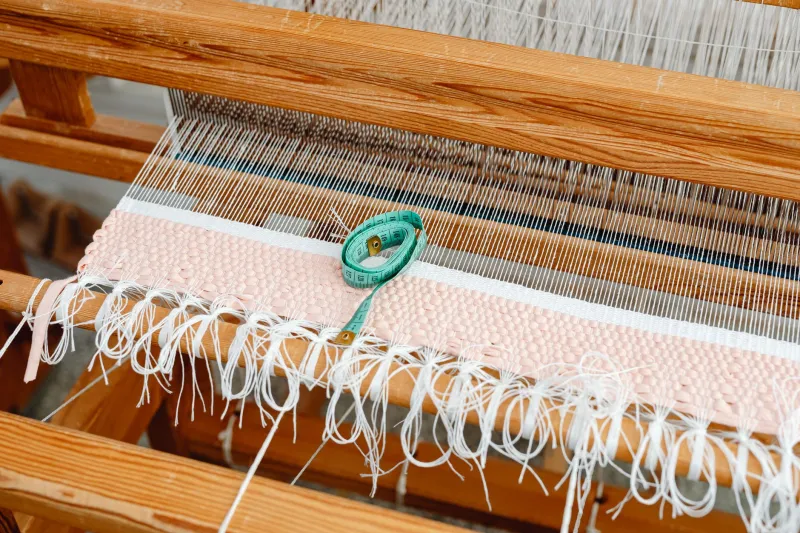
There's a particular quality of light in Rachel Penhaligon's studio that feels almost deliberate. It falls through a wide north-facing window onto bolts of aged wool, rusted shuttle fragments, and half-finished wall hangings in colours that seem to belong to another century — deep madder reds, weld yellows, the kind of blue you only get from woad grown in Somerset soil. It's the sort of place that makes you want to lower your voice.
"I'm not a historian," Rachel says, pushing a mug of tea across a workbench strewn with sample swatches. "But I think I might be a bit obsessed with one."
She's being modest. Over the past decade, the forty-three-year-old Buckfastleigh native has built a reputation that stretches well beyond Devon — her large-scale textile pieces now hang in galleries from Bristol to Edinburgh, and a recent commission for a Tiverton civic building drew coverage in the national craft press. But ask her what drives the work and she'll always bring it back to the same place: the mills.
What the Rivers Left Behind
The West Country was once one of England's great cloth-making heartlands. The fast-running rivers of Devon and Somerset powered fulling mills for centuries, and towns like Tiverton, Honiton, Crediton and Witney built their identities — and their wealth — on the back of the wool trade. By the twentieth century, most of that industry had quietly collapsed, leaving behind empty buildings, faded trade directories, and the occasional loom gathering dust in a local museum.
Rachel grew up hearing fragments of this history from her grandmother, whose own mother had worked the looms at a mill outside Buckfastleigh before the Second World War. "There were these phrases she'd use — names for weave structures, terms for different weights of cloth — that I didn't understand as a child but couldn't forget," Rachel explains. "When I started training as a textile artist in my late twenties, I realised I was essentially trying to decode her."
That decoding process has become her life's work. She spends months researching each new piece, trawling through archive records at Devon Heritage Centre, corresponding with local history groups, and — perhaps most valuably — sitting with older residents whose family memories carry details no document ever captured.
Salvage as Statement
What makes Rachel's work visually distinctive is her commitment to using salvaged materials wherever possible. Old mill cloth, offcuts from defunct manufacturers, even fraying lengths of fabric found in house clearances — all of it finds its way into her studio and, eventually, into her pieces.
"There's something about working with cloth that already has a life in it," she says, holding up a strip of tightly woven wool that she estimates dates from the 1940s. "The fibres have memory. The way they behave on the loom tells you something about how they were made, who made them, what they were for."
The effect in the finished work is remarkable. Her piece After the Flood Leat, currently on loan to a gallery in Exeter, layers strips of salvaged industrial wool with hand-dyed contemporary yarn in a composition that reads, from a distance, almost like an aerial photograph of a river valley. Up close, the textures become almost geological — sedimentary, accumulated, dense with time.
Local collector Martin Ashford, who owns two of Rachel's earlier works, describes the experience of living with them as "quietly unsettling in the best possible way. You notice new things every time you look. A patch of colour that you hadn't clocked before, or a weave structure that suddenly makes you think of something specific — a building, a landscape. She's hidden things in there."
Finding the Others
Rachel is part of a small but growing network of West Country craftspeople who are consciously working to reclaim and reinterpret the region's textile heritage. She mentions Lizzie Truro, a natural dyer based near Totnes who has spent years reviving traditional plant-based dyeing methods using species native to the South West, and a weaving collective in Bridport — a town with its own deep history in rope and net-making — who are experimenting with combining heritage techniques with contemporary design.
"We're not trying to recreate the past," Rachel is careful to say. "That would be nostalgic in a way that doesn't interest me. What we're trying to do is carry something forward. Take the knowledge and the materials and ask what they mean now, in 2024, when the climate is changing and we're all rethinking how things are made."
That political dimension runs through her work more explicitly in recent pieces. A series she completed last year, Spinners, drew on oral histories from women who had worked in Devon's textile industry in the postwar decades — a workforce that was largely female, largely low-paid, and largely written out of the official histories of the trade. The pieces incorporate fragments of their recorded words, printed onto cloth and woven into the structure of each hanging so that the text only becomes legible at certain angles.
"It felt important to make you work for it," she says. "Because that's how their stories have always been — present, but you have to know where to look."
Passing It On
Rachel runs occasional workshops from her studio, and there's a waiting list. She's slightly sheepish about this — "I'm not really a teacher, I just get excited and talk too much" — but those who've attended describe sessions that go well beyond technical instruction. Students come away not just with new skills but with a sense of context, of belonging to a longer tradition.
For Rachel, that continuity is the whole point. The mills are gone. The industry is gone. But the knowledge, the materials, the stories — those are still here, if you go looking.
"Devon doesn't shout about this stuff the way it should," she says, standing back to assess a new piece pinned to the studio wall — deep greens and ochres, the texture of old bark. "We've got this extraordinary heritage sitting in people's attics and local archives and the backs of old ladies' minds. I just want to get it out into the world before it disappears."
She picks up her shuttle, and gets back to work.