Chisels, Dust and Devotion: The Dorset Stonemason Putting Young Hands to Ancient Stone
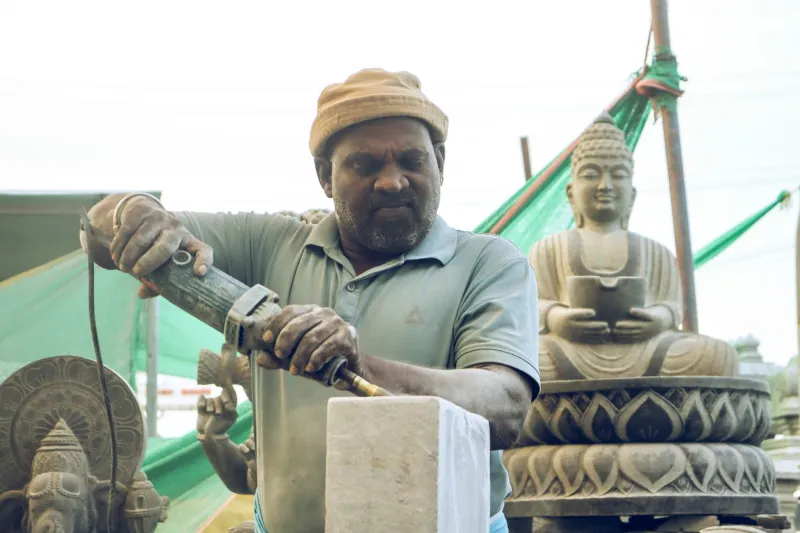
There's a particular sound to a stone yard in full swing. The dry tap-tap-tap of a mallet finding its rhythm, the soft rasp of a bolster working along a bed joint, the occasional grunt of someone realising they've gone a fraction of a millimetre too far. It is, in its own way, a kind of music — and in a modest yard on the edge of the Isle of Purbeck, Ray Holbrook has been conducting it for the better part of four decades.
Ray is 61, broad-shouldered in the way that only a lifetime of physical craft produces, and he has the hands of someone who has spent years in close conversation with limestone. He started as a teenager, sweeping dust and fetching tea for a mason who'd learned his trade from someone who'd learned it after the war. That chain of knowledge — human to human, hand to hand — is precisely what Ray is now fighting to keep intact.
"Stone doesn't forgive impatience," he says, brushing pale dust from his forearms. "That's actually the first thing I tell them. You can't rush it. You can't fake it. The stone always knows."
A Craft on the Brink
Traditional masonry — the kind that involves reading the natural bed of a stone, understanding how frost behaves in a wall, knowing which face to expose and which to protect — has been quietly disappearing for decades. The construction industry largely moved on. Concrete and render became the defaults. Heritage buildings still needed attention, of course, but the pool of people qualified to give it shrank year on year.
Historic England has flagged the shortage of traditional building skills as a genuine crisis. Cathedrals, manor houses, parish churches, dry-stone boundary walls — the fabric of the West Country's built heritage — all of it requires people who understand the old methods. And right now, there simply aren't enough of them.
Ray noticed the problem long before it became an official concern. Around fifteen years ago, he started taking on apprentices in a more structured way, working with a local college to formalise what had previously been informal on-the-job learning. Today, his scheme takes two or three young people each year — some fresh from school, some who've tried other paths and found them wanting — and puts them through a rigorous, patient, deeply hands-on education in the craft.
Why Young People Are Coming Back
You might expect this to be a story about reluctant recruits, about cajoling teenagers away from screens and into a dusty yard. But Ray tells it differently.
"The ones who come to me, they're hungry for it," he says. "There's something happening out there — people want to make things that last. They're fed up of flat-pack and fast fashion and jobs that don't leave anything behind. Stone leaves something behind."
Currently working alongside Ray is Priya, 23, who spent a year studying architecture before deciding she wanted to understand buildings from the ground up rather than the drawing board down. And there's Marcus, 19, a Weymouth lad who'd done a stint in a warehouse and found himself yearning for something he couldn't quite articulate until he picked up a chisel for the first time.
"I didn't know this was what I was looking for," Marcus admits, pausing to examine the edge of a piece of Portland stone. "But the first time I dressed a stone properly — got it flat, got the arris clean — I felt something I'd never felt in any other job. Like I'd actually done something."
Priya nods. "There's a meditative quality to it, once you get past the frustration. And the frustration is real — don't let anyone tell you it isn't. But on the other side of it is something genuinely satisfying."
The Techniques That Time Built
Ray's teaching is methodical and deeply specific. He starts apprentices on rubble walling — understanding how stones interlock without mortar, how weight distributes, how a wall breathes. From there, they progress to ashlar work: the precise cutting and dressing of squared stone that defines so much of Dorset's finest buildings.
He teaches them to identify the natural bed — the plane in which the stone was originally laid down over millions of years — and to respect it. Lay a stone against its bed, he explains, and moisture gets in, frost gets to work, and within a generation your careful repair has become a problem. Lay it correctly, and it might outlast everyone in the room by several centuries.
"Purbeck marble, Portland limestone, Ham Hill stone from Somerset — they all behave differently," Ray explains, moving between examples with the ease of someone who has given this particular lesson many times. "You have to learn the personality of each one. What it likes, what it doesn't. You can't treat them all the same."
There are lessons in lime mortar — why modern cement is often the enemy of old stone, trapping moisture rather than allowing it to move — and in the reading of historic buildings: understanding how a Victorian restoration might have introduced problems that are only now becoming visible, or how a medieval wall was built to a logic that still makes perfect sense if you know how to look.
Connected to Something Larger
What strikes you, spending time in Ray's yard, is the sense of deep continuity. The tools haven't changed much. The stone certainly hasn't. The methods being taught today are recognisably the same methods that raised Sherborne Abbey and Corfe Castle and the long limestone terraces of Weymouth's Georgian seafront.
Ray is quietly aware of this, though he's not the sort to get misty about it.
"I'm not a museum piece," he says firmly. "And I don't want my apprentices to be museum pieces either. This is a living trade. There's real work to be done — restoration, conservation, new builds that want to sit properly in the landscape. The heritage stuff matters, but so does building well for the future."
His scheme has now sent a dozen or so qualified masons out into the world. Several work on cathedral and church restoration projects across the South West. One has set up his own practice in Shaftesbury. Another went north to work on a major heritage project in Yorkshire. All of them, Ray says, keep in touch.
"That's the thing about a proper apprenticeship," he reflects. "You don't just pass on skills. You pass on a way of thinking. A way of being careful and honest with your work. That sticks with people."
The Work Continues
As the afternoon light shifts and the yard takes on that particular golden quality that Dorset does so well in early autumn, Ray sets Marcus a new task — a piece of awkward-shaped Purbeck that needs to be worked into a quoin for a repair job on a farmhouse wall near Langton Matravers. Marcus studies it for a long moment, turning it in his hands, before reaching for his mallet.
Ray watches, says nothing, lets the young man think.
Somewhere in that silence is the whole point of what's happening here: the patient transmission of knowledge that took centuries to accumulate, being carried forward one careful chisel stroke at a time.
The stone, as always, is waiting.