Smoke, Starter and Stubbornness: The Village Baker Waging a Quiet War on Factory Bread
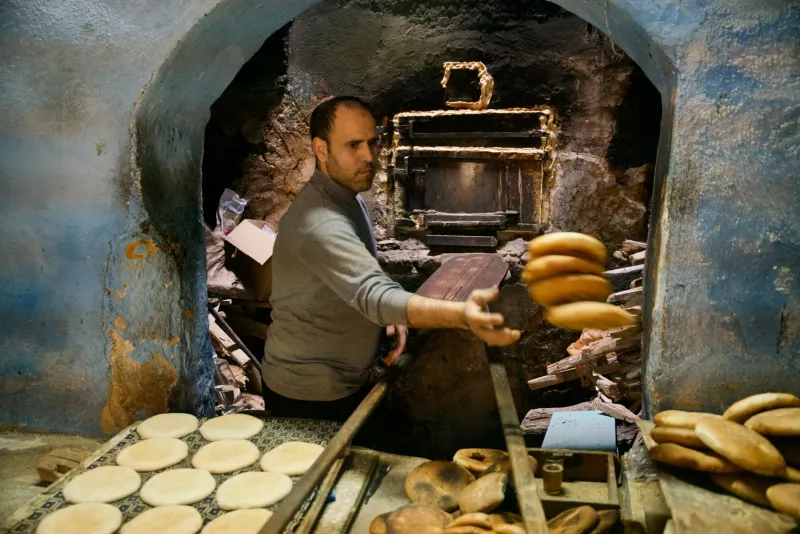
The smell hits you before the building does. Woodsmoke, warm crust, something faintly sour and deeply ancient — the kind of smell that bypasses your brain entirely and lands somewhere much older. It's half past five in the morning in a small Somerset village, and Rowan Trescothick is already three hours into her day.
The bakehouse she works from had been locked up for the better part of forty years when she first pushed the door open. The stone oven was intact, the paddle hooks still on the wall, the floor flagged in the same pale limestone it had always been. What was missing was someone willing to do the work.
"People kept walking past it and saying what a shame," Rowan says, brushing flour from her forearms. "I got tired of agreeing with them."
A Loaf With a Long Memory
Rowan grew up in Bristol, trained as a graphic designer, and spent a decade working in London before what she cheerfully describes as "a fairly predictable breakdown of priorities" brought her west. She'd been baking at home for years — sourdough, mostly, the kind that takes days rather than minutes — but it wasn't until she moved to Somerset and started asking questions about the village bakehouse that things got serious.
The history of the building, it turned out, was the history of the village itself. It had been the social and practical hub of the community for well over a century, the place where families brought their Sunday joints to be slow-roasted in the residual heat after the bread was done, where news was exchanged, where the rhythms of the week were quietly organised. It closed in the early 1980s, a casualty of cheap supermarket bread and changing habits, and had sat silent ever since.
Restoring the oven alone took eighteen months and the help of a retired stonemason from Shepton Mallet who'd worked on bread ovens before and knew where the heat needed to live. "He kept telling me I was mad," Rowan says. "But he kept coming back, so."
The Long Rise
What Rowan produces now is bread that runs entirely counter to the logic of modern food production. Her sourdough is made with a starter she's been feeding for six years — a living culture of wild yeast and bacteria that she talks about with the kind of affectionate exasperation usually reserved for difficult relatives. Each loaf takes the better part of two days from mix to crust. There is no improver, no ascorbic acid, no flour treatment of any kind. Just grain, water, salt, time and fire.
The wood-fired oven runs on apple and oak from local orchards and managed woodland. It takes four hours to bring up to temperature and holds its heat for a long, slow bake that Rowan says no electric deck oven can properly replicate. "The crust is different. The crumb is different. The way it keeps is different. People who grew up eating proper bread recognise it immediately. They go a bit quiet."
She bakes twice a week, produces somewhere between sixty and eighty loaves per session, and has a waiting list that she refuses, on principle, to extend beyond the village and the two nearby market towns she supplies. "If I scale up, I compromise something. I've watched enough people do that. The thing that made it special quietly disappears and you're left wondering what happened."
Teaching the Next Pair of Hands
What's perhaps most striking about Rowan's operation is that she's not trying to keep it to herself. Over the past two years she's taken on three apprentices — none of them with professional catering backgrounds, all of them drawn in by the same combination of stubbornness and curiosity that brought her here in the first place.
Jamie, twenty-three, was working in a warehouse in Taunton. Priya, who's thirty-one, had been a secondary school science teacher and brings an almost forensic interest in the microbiology of fermentation. The third, an older man named Derek who won't give his age but whose hands suggest decades of outdoor work, turns up every Thursday and Saturday without fail and says very little except when the bread is wrong, at which point he says quite a lot.
"What I'm trying to pass on isn't a recipe," Rowan explains. "It's a way of paying attention. You have to learn to read the dough. You have to learn to read the fire. You can't rush either of them."
The apprenticeships are informal, unpaid in the traditional sense — though Rowan gives each of them bread, produce and a small stipend drawn from the bakery's modest surplus — and structured around the rhythms of the oven rather than any formal curriculum. There are no certificates at the end. What there is, she hopes, is the knowledge and confidence to go and do the same thing somewhere else.
What Factory Bread Took From Us
Rowan is careful not to be preachy about any of this, and she's the first to acknowledge that cheap industrial bread fed a lot of people who couldn't afford anything else. But she's also clear-eyed about what the Chorleywood process — the high-speed, additive-assisted method that transformed British bread production in the 1960s and now accounts for the vast majority of what's sold in UK supermarkets — quietly removed from communities like this one.
"It didn't just change the bread. It changed the relationship between people and their food. It changed the relationship between people and each other. The bakehouse wasn't just a place where bread happened. It was infrastructure. Social infrastructure. And when it went, something went with it that we haven't properly named yet."
There's a community noticeboard on the bakehouse wall now. People leave seeds, swap produce, arrange lifts. On bake days, there's usually a small cluster of people outside waiting — not just for their loaves, but for the conversation that comes with them.
Still Rising
Rowan doesn't have grand plans. She's not pitching to investors or building a brand. She'd like, eventually, to see the apprentices running their own operations — maybe another dormant bakehouse somewhere, maybe a market stall, maybe something else entirely. She'd like the starter to outlive her, which she mentions with a completely straight face.
For now, she's got wood to stack, a fire to light, and a dough that's been proving overnight and will need attention in about twenty minutes.
"Good bread," she says, pulling on her apron, "takes as long as it takes. That's not a flaw in the process. That's the whole point."
The smoke is already rising from the chimney. The village, slowly, is waking up.