Salt, Nets and Stubbornness: The Cornish Fisherman Who Won't Let the Old Ways Sink
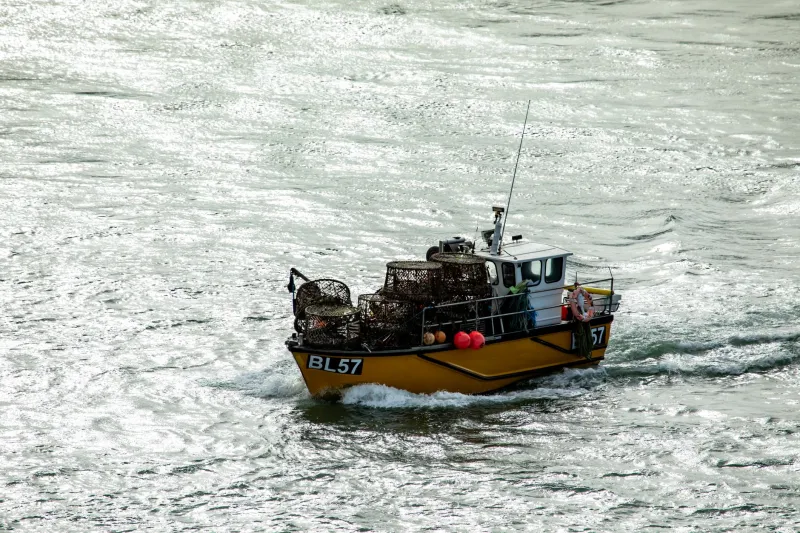
The harbour at Newlyn is stirring before six. Gulls are already making a racket overhead, ropes creak against their cleats, and somewhere beneath the low cloud a diesel engine coughs to life. Most of the boats heading out this morning are big — wide-beamed, hydraulic-winched, GPS-guided vessels that can cover serious ground in serious time. And then there's Mick Treloar's Kerensa, a 28-foot wooden lugger that looks, frankly, like it belongs in a museum.
Mick wouldn't have it any other way.
"She's a working boat," he says, without a trace of apology. "Always has been. I'm not keeping her pretty. I'm keeping her fishing."
At 61, Mick is one of a shrinking number of Cornish fishermen still practising hand-line and traditional net methods — specifically the drift netting techniques once used to chase the vast shoals of pilchards that made places like Newlyn, Mousehole, and Mevagissey famous across Europe. At their peak in the nineteenth century, Cornish pilchard fisheries were exporting millions of fish to Catholic countries in southern Europe, particularly Italy and Spain. The seine boats and their crews were the economic backbone of dozens of coastal villages. Now, Mick will tell you, you can count the people who know how to do it properly on one hand.
What the Industrial Fleet Changed
The decline of the Cornish pilchard — or sardine, as the younger fish are now marketed — is a complicated story involving climate shifts, changing sea temperatures, and the long shadow of industrial trawling. Mick isn't one to point fingers crudely, but he's clear-eyed about what happened.
"When the big boats came in with their purse seiners and their sonar, they weren't fishing — they were hoovering. You can't do that indefinitely and expect the stocks to hold."
Small-scale, selective netting — the kind Mick practices — takes more time, more skill, and catches far fewer fish per trip. It also damages the seabed considerably less, causes far lower levels of bycatch, and allows populations to recover between seasons. But in a market that rewards volume and punishes patience, those virtues don't always translate to a viable living.
"I'm not going to pretend it's easy money," he admits, pouring tea from a flask as we sit on the quayside. "Some weeks I'm barely breaking even. But I sell direct — restaurants, local markets, a few regular households — and I get a fair price because people know what they're getting. Line-caught, day-fresh, handled properly. That's worth something to the right buyer."
The Apprentices
What's made Mick something of a local figure in recent years isn't just his stubborn loyalty to old methods — it's what he's started doing with them. Three years ago, he began taking on young people from the surrounding area, teaching them the basics of traditional netting, navigation by tide and wind, fish identification, and the kind of intuitive sea-reading that no app can replicate.
"The first lad I took on was nineteen. Couldn't tie a bowline. Never been on anything smaller than a ferry. Six months later he was mending his own nets and reading the water better than most."
He now runs informal apprenticeships — two or three at a time, often in partnership with a local college — and has become something of an unlikely advocate for what he calls "slow fishing." It's a term borrowed loosely from the slow food movement, and the parallel is deliberate. Just as artisan cheesemakers and heritage breed farmers have found audiences willing to pay more for produce made with care and tradition, Mick believes there's a market — and a cultural argument — for fishing done the same way.
"People are interested in where their food comes from now. They want to know it wasn't scraped off the bottom of the ocean by a boat the size of a car park. If I can show them what the alternative looks like, maybe that changes something."
What Gets Lost
But Mick is also honest that this isn't just about economics or ecology. There's something less quantifiable at stake when traditional maritime skills vanish from a community — a kind of knowledge that's inseparable from place, from identity, from the particular way a coastal village understands itself.
Cornwall's relationship with the sea is not decorative. It's not a backdrop for holiday snaps or a theme for pub names. For centuries it was the literal foundation of how people here survived, what they ate, how they organised their days and their years. The vocabulary, the superstitions, the songs, the saint's day customs — all of it grew out of a life lived in close, often brutal proximity to the water.
"My grandfather knew things about this stretch of coast that I'm still trying to learn," Mick says quietly. "And I know things that'll disappear when I'm gone, unless someone bothers to pay attention."
He doesn't say it dramatically. He's not a man given to grand statements. But the weight of it sits there between us, as solid as the harbour wall.
A Different Kind of Future
There are, cautiously, reasons for a degree of optimism. The pilchard — sorry, the Cornish sardine — has made something of a comeback in recent years, partly due to warming waters pushing the shoals north, and partly because of renewed consumer interest in sustainable, locally caught fish. A handful of chefs across Cornwall and further afield have become vocal champions of the day-boat catch, and Mick's fish regularly end up on menus in Penzance, Falmouth, and occasionally as far as Bristol.
His apprentices, meanwhile, are starting to find their feet. One has gone on to skipper her own small boat. Another is combining traditional methods with a small community-supported fishery scheme, where local households pay a weekly subscription in exchange for a regular box of whatever came in that morning.
"It's not going to save the world," Mick concedes, rinsing out his mug. "But it's something. It keeps the knowledge moving."
He stands, squints out at the water, and does the kind of unconscious calculation that only comes from decades of looking at the same stretch of sea. The Kerensa is waiting. The tide is about right.
"You coming out?" he asks.
Some questions, it turns out, answer themselves.