Hammer, Tin, and Time: The Devon Man Refusing to Let a Centuries-Old Craft Go Quiet
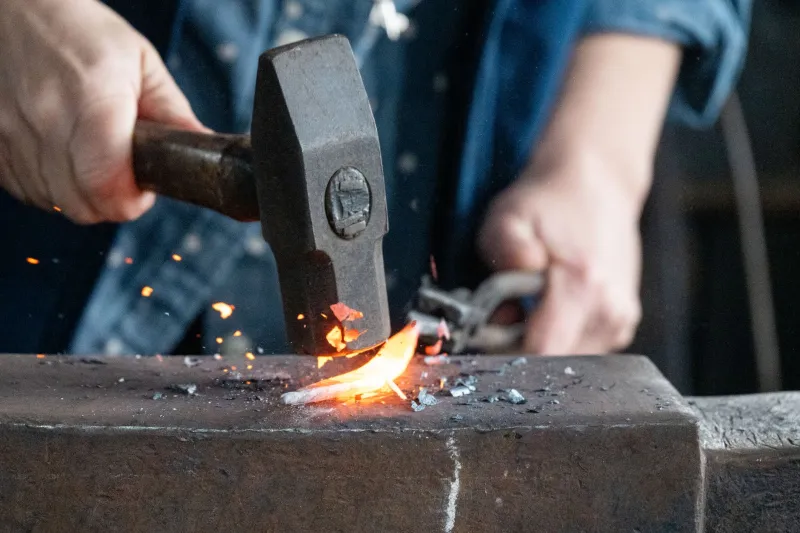
The smell hits you before anything else. A faint metallic tang, warm and oddly comforting, drifting out from a low stone building just off a muddy lane outside Moretonhampstead. Inside, Rob Trevithick is bent over a workbench, coaxing a flat sheet of tinplate into the curved body of a traditional Devon cream pot — the kind that once sat on every farmhouse dresser from Bude to Brixham.
He's been at this bench, give or take, for thirty-one years. And depending on who you ask, he's the last person in the county — possibly the country — still doing it the old way.
"People always look a bit surprised when I tell them what I do," he says, not looking up from the seam he's soldering. "They think tinsmithing's a museum job. Something you read about on a National Trust plaque."
It's not. Not here, anyway.
What Actually Is a Tinsmith?
Before we go any further, it's worth clearing something up — because there's a fair bit of confusion out there. Tinsmiths don't work with pure tin. The material is tinplate: thin sheets of steel coated in a fine layer of tin to prevent rust. It's been used for everything from kitchen storage to lanterns, hip flasks to cattle feed funnels, for well over three centuries.
At its peak in the 18th and 19th centuries, tinsmiths were as common in market towns as blacksmiths. Every village had someone who could knock up a watering can or patch a leaking pail. Then came mass production. Then came plastic. And one by one, the workshops closed.
Rob's didn't.
He inherited the trade — and the tools — from his uncle, a man called Dennis who'd learnt it from a bloke in Tavistock who'd learnt it from someone else entirely, in a chain of knowledge stretching back to the early 1700s. "The mallet I use most days," Rob says, holding up a worn wooden-handled tool with an almost reverential air, "Dennis reckoned was made around 1890. I've no idea if that's true. But I've never found a reason to replace it."
A Day in the Workshop
The workshop itself is a glorious, chaotic thing. Tin snips hang from hooks alongside patterns cut from old cardboard. Rolls of tinplate lean against the wall like metallic wallpaper. A battered radio plays Radio 2. There are moulds and mandrels, stakes and swage blocks — most of them without modern equivalents, sourced from estate sales, old tool merchants, and the occasional tip-off from a retired engineer.
Rob works largely to commission. A local farm shop recently ordered a set of bespoke display tins for their deli counter — the sort with hand-rolled rims and tight-fitting lids that keep Cornish biscuits crisp and look considerably more handsome than anything you'd find in a catering catalogue. A pub near Totnes wanted reproduction Victorian tankard holders for their bar. A Dartmoor glamping site asked for a run of traditional candle lanterns.
"People want things that look like they belong somewhere," he explains. "Not like they fell off a lorry from a warehouse in Swindon."
It's a sentiment that's clearly landing. Enquiries, he says, have picked up noticeably over the past three or four years — driven partly by a broader appetite for locally made goods, and partly by the growing number of food and drink businesses in the South West who want their branding to feel genuinely rooted in the region.
The Apprenticeship Question
For a long time, Rob worked alone. There was nobody to teach, and frankly, nobody asking. But last year, something shifted. A 24-year-old from Exeter named Cara Penrose got in touch after watching a short film about traditional crafts on YouTube. She asked if she could come and watch. Then if she could try. Then if she could come back.
She's now spending two days a week in the workshop, learning to cut, fold, seam, and solder. Progress, Rob admits, is slow — not because Cara isn't capable, but because the craft genuinely doesn't have shortcuts.
"You can't just watch a tutorial," he says. "Your hands have to learn it. The pressure, the angle, the feel of when the metal wants to move and when it's going to fight you. That takes time."
Cara, for her part, is philosophical about the pace. "I came from a graphic design background," she tells us over tea in the workshop doorway. "Everything digital is instant — you can undo anything. This is the opposite of that. Every mark you make is permanent. It's terrifying and brilliant at the same time."
There's something quietly significant about this passing of knowledge. No formal qualification exists for tinsmiths in the UK. There's no apprenticeship scheme, no trade body, no NVQ pathway. Everything Rob knows came from Dennis, and everything Dennis knew came from someone before him. If that chain had broken — if Rob had packed it in ten years ago, or if Cara hadn't sent that first email — a tradition spanning three centuries would have simply... stopped.
Why It Matters Beyond Nostalgia
It would be easy to frame this as a heritage story — a warm piece about old things surviving against the odds. And there's truth in that. But there's also a more practical argument for keeping skills like Rob's alive.
Bespoke tinwork is genuinely useful. It's durable, repairable, and recyclable in ways that plastic alternatives simply aren't. A well-made tin canister, Rob reckons, will outlast its owner. He's repaired pieces brought in by customers whose grandparents bought them new. "Nobody brings me a broken Tupperware to fix," he notes drily.
For the region's thriving food and drink scene — the farm shops, the artisan producers, the cider makers and cheesemakers who've built their identities around provenance and craft — there's a natural affinity with what Rob does. Packaging and display that's genuinely handmade, genuinely local, and genuinely old in its methods carries a kind of authenticity that no amount of marketing spend can replicate.
Something Worth Keeping
By mid-morning, the cream pot is finished. Rob holds it up to the light coming through the workshop's small, grubby window. The seam is clean. The lid fits with a satisfying snug click. It's a simple object, unremarkable to look at — and somehow, quietly extraordinary.
Thirty-one years of practice in a single pot.
"I don't think about legacy much," Rob says, setting it down on the bench. "I just think about the next job. But I suppose it would be a shame if this stopped, wouldn't it?"
It would, Rob. It really would.
Rob Trevithick takes commissions for bespoke tinwork from his workshop near Moretonhampstead. Enquiries via local craft directories or by word of mouth — which, in Devon, remains the most reliable method.