Mud, Memory and the Magic of the Kiln: One Cornish Potter's Fight to Keep Ancient Craft Alive
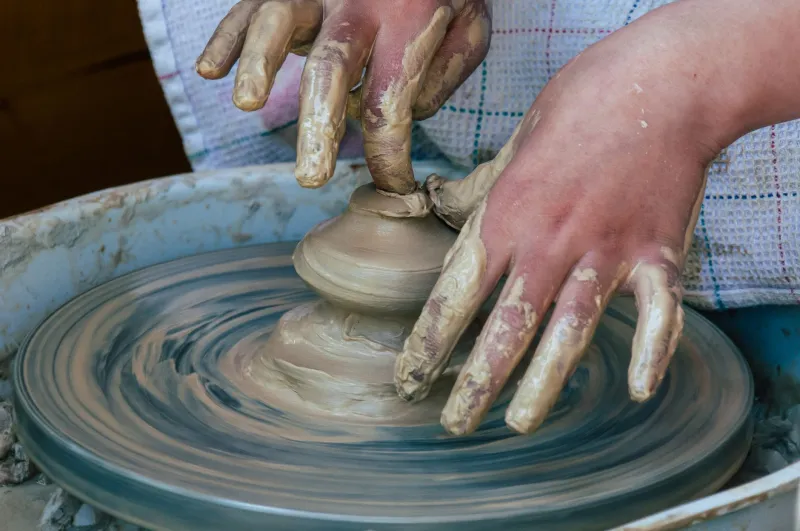
The studio smells of damp earth and wood smoke. Shelves line every wall, crowded with bowls and jugs in various states of becoming — some raw and pale, others glazed in the deep ochres and sea greens that have come to define Margaret Treloar's work. Outside, a Cornish drizzle taps against the skylight. Inside, a twenty-two-year-old named Callum is up to his elbows in clay, frowning at a lopsided rim like it's personally offended him.
"Slower," Margaret says, not unkindly. "You're rushing it. The clay knows."
It's the sort of thing that might sound a bit mystical out of context. In here, it makes perfect sense.
Margaret, who turned sixty-eight last spring, has been working with clay since she was a teenager in Redruth. She trained formally in the 1970s, back when studio pottery still had a genuine foothold in British craft culture — before the supermarkets started shifting six-piece dinner sets for a tenner and people stopped thinking too hard about where their mugs came from. She retired from teaching ceramics at a further education college in Truro four years ago, and rather than putting her feet up, she opened this place: a small, slightly chaotic workshop on the edge of a village just inland from the Helford Passage.
She calls it, with characteristic lack of fuss, The Shed.
What's Actually Being Lost
To understand why what Margaret does matters, it helps to know what she's working against. Modern pottery — the kind you'll find stacked high in any homeware chain — is almost entirely slip-cast or jiggered in factories, often overseas. The clay is standardised, the glazes are chemical approximations of natural finishes, and the whole process is engineered to produce identical objects at volume. Nothing wrong with that, necessarily. But it means that the older techniques — hand-throwing on a kick wheel, natural ash glazing, once-firing in a wood-burning kiln — have become genuinely rare skills. Not rare like niche hobbies. Rare like they're quietly vanishing.
"There are methods I use that I had to piece together from old books and conversations with potters who are now in their eighties," Margaret says, warming her hands on a mug of tea. "Nobody wrote it all down properly. It was passed on person to person, and at some point the chain broke. I'm trying to reconnect a few of those links before it's too late to bother."
The techniques she's most passionate about preserving include traditional Cornish earthenware methods that predate the industrialisation of ceramics by several centuries — approaches rooted in the county's own geology, using locally sourced clays and naturally occurring minerals for glazing. The results are pieces that look nothing like what you'd find in a shop. They're irregular, individual, and built — her word, used deliberately — to last.
"A well-made hand-thrown pot, fired properly, will outlive everyone in this room," she says. "Probably everyone in the village. That's not nothing."
The Apprenticeship
Callum Pascoe grew up in Falmouth and had never touched clay before he turned up at The Shed eighteen months ago, having seen a handwritten card in a local café window. He's one of three young people Margaret currently works with informally — not quite apprentices in the traditional sense, not quite students either. She doesn't charge them, and she doesn't pay them. What she offers is time, knowledge, and the occasional blunt critique.
"She told me my first ten bowls were basically binnable," Callum says cheerfully. "Which was fair. They were."
The arrangement is deliberately low-key. Margaret isn't running a formal school and has no interest in doing so. What she wants is for the skills she carries to exist in other people's hands before she's no longer around to demonstrate them. It's an ancient model — craft knowledge transferred through proximity and practice — and she's convinced it's still the only one that actually works.
"You can watch videos online until your eyes go square," she says. "You will not learn to throw a pot from a video. Your hands have to fail at it a thousand times before they start to understand."
The other two working with her are a woman in her mid-thirties who came to pottery after leaving a career in finance, and a sixteen-year-old doing it alongside his GCSEs. The range, Margaret says, is intentional. Different people bring different things to the clay.
Against the Throwaway
There's a broader argument running underneath all of this, and Margaret doesn't shy away from it. The explosion of cheap, disposable homeware — the kind that chips after three months and ends up in landfill — is something she finds genuinely troubling, not just aesthetically but ethically.
"We've completely lost the idea that an object in your home could be something you care about," she says. "Something with a bit of history to it. People used to save up for a decent piece of pottery. Now they buy a set of four bowls for the price of a sandwich and throw them out when they get bored of the colour."
Her own pieces sell — through word of mouth, a small website, and the occasional craft fair — at prices that reflect the time and skill involved. A single hand-thrown bowl might cost thirty or forty pounds. She's aware that's not accessible to everyone, and she's thought about it carefully.
"I'm not pretending this is for everybody. But I think there's value in at least some people owning things that were made with care and will last. It changes your relationship with objects. It changes how you think about making."
Something Worth Holding Onto
By mid-afternoon, Callum's rim has been sorted. He's moved on to trimming the base, and the concentration on his face has shifted from frustration to something closer to absorption. Margaret watches for a moment, says nothing, and goes back to her own wheel.
The kick wheel — a heavy, traditional design she's had for thirty years — turns with a satisfying rhythm. Her hands move over the clay with a confidence that looks effortless and absolutely isn't. Outside, the rain has picked up. A wood pigeon is making a fuss somewhere in the eaves.
It's not a dramatic scene. There's no grand narrative arc playing out, no climactic moment. Just a woman in her late sixties, in a shed in Cornwall, passing something on.
Which is, when you think about it, exactly how it's always been done.