Lights, Camera, Clovelly: The West Country Locations That Keep Upstaging the Stars
There's a moment in the second series of a certain beloved Cornish period drama where the hero rides his horse along a headland so dramatically lit it looks almost too beautiful to be real. Viewers assumed it was shot somewhere remote, wind-battered, and difficult to reach. It was, in fact, about twenty minutes from a National Trust car park and a very good pasty shop.
The West Country has been making television and film look effortlessly gorgeous for decades. But the relationship between these locations and the productions that use them is more complicated — and more interesting — than a simple postcard shot suggests. We spoke to location managers, local business owners, and the people who actually live in these places to find out what it's really like to be a backdrop.
1. Charlestown Harbour, Cornwall — The Georgian Port That Never Left the Eighteenth Century
If you've watched Poldark, you've seen Charlestown. If you've watched Outlander, you've seen Charlestown. If you've watched The Three Musketeers, or any number of other period productions requiring a working Georgian harbour with actual tall ships, you've almost certainly seen Charlestown — probably without realising it was the same place every time.
The harbour near St Austell is, genuinely, one of the most intact eighteenth-century port landscapes in Britain. Its lock gates, quaysides, and resident fleet of tall ships make it a location manager's dream and a continuity editor's gift.
"We get approached probably fifteen to twenty times a year," says a spokesperson for the Charlestown Harbour estate. "We have to be selective. You can't have three different productions all claiming to be the same fictional port."
For local businesses, the benefits are real but double-edged. Footfall increases whenever a series airs, sometimes dramatically. But filming itself can close the harbour for days at a time, frustrating residents and regular visitors alike. "It's brilliant for us in the long run," says one café owner near the quayside. "But when they're actually here, it's chaos."
2. West Bay, Dorset — The Town That Became Broadchurch
Few transformations have been as total — or as commercially significant — as what happened to the small Dorset harbour town of West Bay after ITV's Broadchurch began airing in 2013. The show, starring Olivia Colman and David Tennant, used the town's distinctive golden sandstone cliffs and compact seafront as the fictional Broadchurch, and the effect on visitor numbers was immediate and lasting.
"It changed things here overnight," says local guesthouse owner Patricia Hale, who has run her B&B near the seafront for over twenty years. "We started getting people coming specifically to walk the locations. Some of them had printed maps from the internet. Some of them cried on the beach. It was quite something."
The town has leaned into its screen identity with varying degrees of enthusiasm. A few businesses have embraced the Broadchurch connection openly; others are quietly tired of it a decade on. The cliffs, meanwhile, don't care either way. They're still there, still spectacular, and still appearing in productions that need something dramatic and coastal without the cost of going somewhere more exotic.
3. Lacock, Wiltshire — The Village That Is Basically a Film Set Already
Technically on the eastern edge of what most people consider the West Country, Lacock has appeared in so many productions that listing them all risks becoming tedious. Pride and Prejudice (both the 1995 BBC version and the 2005 film). Downton Abbey. Wolf Hall. Harry Potter. The Village. Cranford. It goes on.
The reason is straightforward: almost the entire village is owned by the National Trust, meaning there are no modern shop fronts, no satellite dishes, no parked cars with current plates visible in the wrong shot. Strip out the tourists and their smartphones, and Lacock looks convincingly like any century between the fifteenth and the early twentieth.
"We're very used to it now," says one resident who has lived in the village for thirty years. "You just come home one day and there's a camera crew in your street. You learn to go around."
The National Trust manages filming access carefully, balancing the income it generates against the impact on residents and regular visitors. It's a delicate act — and one that other heritage locations across the West Country are watching closely.
4. Dartmoor, Devon — The Moor That Plays Every Moor
Dartmoor is, cinematically speaking, remarkably versatile. It has stood in for the Yorkshire Moors (repeatedly), the Scottish Highlands (occasionally), and various unspecified bleak wildernesses too numerous to catalogue. Its granite tors, boggy valleys, and genuinely changeable weather make it a location that can look threatening, romantic, or apocalyptic depending on the time of day and the director's brief.
The Hound of the Baskervilles has been filmed here so many times that local guides sometimes joke the moor owes Conan Doyle a commission. More recently, it's provided backdrops for everything from literary adaptations to car adverts shot to look like something altogether more remote.
For the Dartmoor National Park Authority, managing filming is an ongoing logistical exercise. Large productions require permits, environmental impact assessments, and careful management of access routes. Smaller crews sometimes simply arrive and hope for the best, which doesn't always go well.
"We want to support the industry," says a park spokesperson. "But Dartmoor is a living landscape with working farms, fragile habitats, and communities. It's not a studio backlot."
5. Portleven, Cornwall — The Harbour Town Having Its Moment
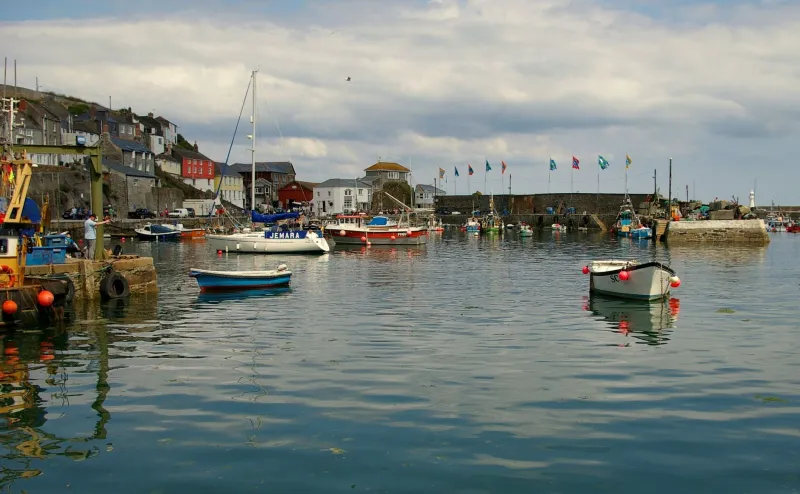
Portleven is the newest entry on this list, and arguably the most interesting. The working fishing harbour on the Lizard Peninsula has appeared in several recent productions, including elements of the Doc Martin universe and various streaming originals that prefer not to advertise their locations too loudly for fear of overwhelming a place that is, frankly, not built for mass tourism.
"We're still quite small," says local fisherman and part-time location extra Dave Trevithick, who has appeared in the background of at least two productions he can remember and possibly several he can't. "We don't want to become the next Broadchurch. That's not a criticism — it just isn't who we are."
That tension — between the economic opportunity that screen exposure brings and the desire to remain an actual community rather than a visitor attraction — runs through every location on this list. The West Country is extraordinarily photogenic. It has always known this. The question it's still working out is what it wants to do about it.
The Bigger Picture
Location coordinator Sarah Jennings, who has worked on productions across Devon and Cornwall for the past fifteen years, puts it plainly: "The West Country keeps getting chosen because it looks like nowhere else in Britain. That's a gift. But it also comes with responsibility — to the places, the people, and the landscapes that make it all possible."
The cameras will keep coming. The cliffs and harbours and moors will keep looking magnificent. And somewhere in a village that hasn't quite realised what's about to happen to it, a location manager is already walking the streets with a camera and a very promising expression on their face.