Let It Go Wild: The West Country Gardeners Tearing Up the Rulebook One Lawn at a Time
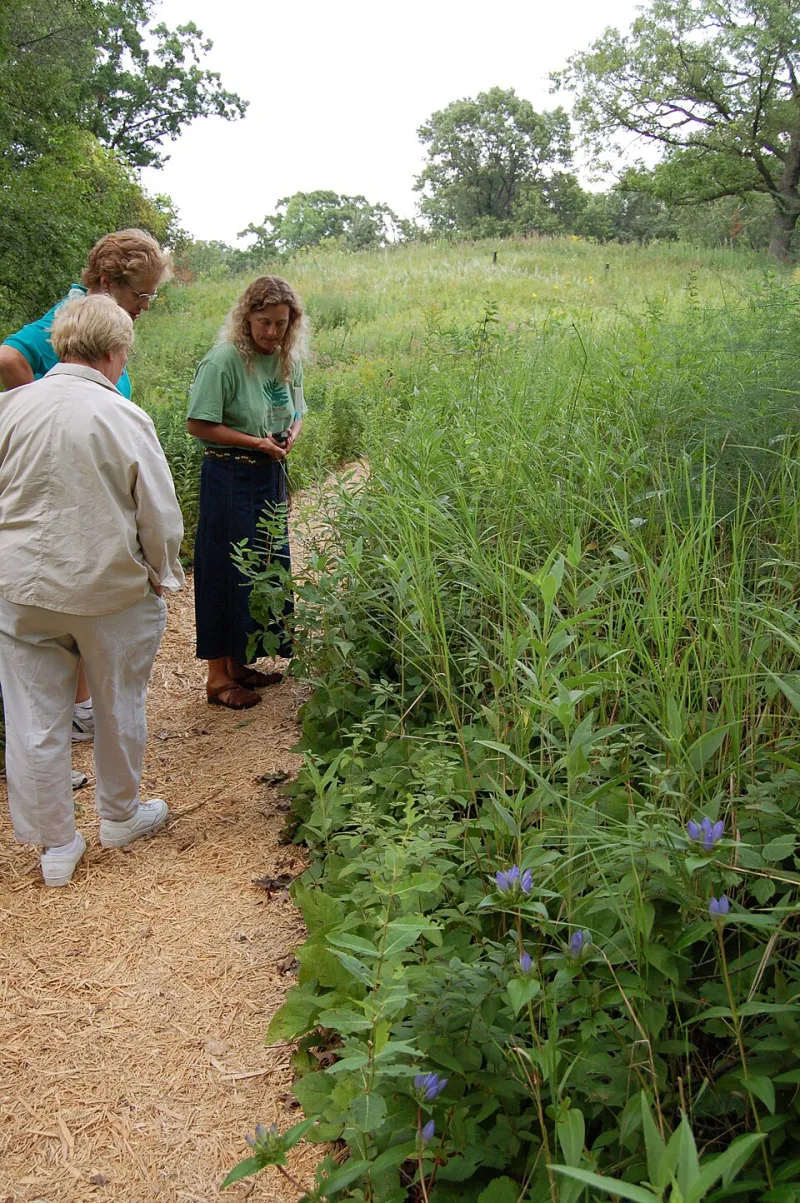
Photo: A. E. Crane, U.S. Department of Transportation, Public domain, via Wikimedia Commons
Pat Hennessy's front garden is, by traditional standards, a complete state. There's a patch of ox-eye daisies muscling in on what used to be a neat border. A stand of teasels has taken over the corner where she once kept a rather apologetic rose. The lawn — if you can still call it that — is a shaggy patchwork of clover, self-heal, and something she thinks might be wild marjoram but hasn't quite confirmed yet. Her neighbour spent two weeks not speaking to her about it.
"Then he noticed the butterflies," she says, grinning. "He's got a wildflower strip along his fence now. Took him about a month to come round."
Pat lives on the outskirts of Taunton, and she is, in the politest possible sense, part of a movement that is quietly dismantling one of Britain's most stubborn cultural obsessions: the perfect lawn.
The Tyranny of the Stripe
The manicured garden — symmetrical borders, weedless beds, a lawn with the kind of stripes that suggest someone has too much time and not enough ecological anxiety — has been an aspirational ideal in British suburbia for generations. It signals respectability. Order. A certain kind of homeownership that says I am in control of my immediate environment, thank you very much.
But the cracks are showing, and not just in the parched, yellowing turf that characterised last summer's drought. Across the West Country, a significant and growing cohort of gardeners is actively choosing a different approach — one rooted in ecology, food production, and a fairly fundamental rethink of what a garden is actually for.
"A monoculture lawn is basically a green desert," says Tom Baxter, who runs permaculture workshops from his smallholding near Totnes and has been advocating for what he calls 'productive wildness' for over a decade. "Nothing lives in it. Nothing eats from it. It takes water, it takes chemicals, it takes hours of your weekend, and it gives back almost nothing. People are finally starting to question whether that's a sensible use of land."
His workshops, which were selling out modestly before the pandemic, are now oversubscribed months in advance. Waiting lists have waiting lists.
Rewilding the Terrace
It would be easy to frame this as a rural phenomenon — the preserve of people with enough space to create genuine wildlife corridors and the kind of acreage where you can let a meadow do its thing without the neighbours noticing. But that's not what's happening.
In Exeter, Plymouth, and Bristol, community gardening groups are transforming small urban plots, verges, and forgotten scraps of council land into thriving pollinator habitats. In Falmouth, a network of terraced house owners has been quietly coordinating to create what they call a 'garden chain' — connecting their back gardens with native planting to give hedgehogs, insects, and birds a continuous habitat corridor through the town.
"You don't need acres," says Meera Patel, who coordinates the Falmouth group and manages to grow an impressive amount of food in her own 15-metre back garden. "You need intention. You need to stop treating your garden like it needs to look like the Chelsea Flower Show and start treating it like it's part of an ecosystem. Because it is."
Her plot includes a raised vegetable bed, a small pond she dug herself, a section of unmown grass, and a compost corner that she describes, with evident pride, as "genuinely disgusting and absolutely thriving."
The Politics of Mess
For all the enthusiasm, it would be naive to pretend this is a frictionless revolution. The aesthetic of the rewilded garden remains contentious in ways that reveal something interesting about class, conformity, and the social pressure that comes with living in close proximity to other people's opinions.
"There's a real gatekeeping thing that happens," admits Tom Baxter. "If you're in a detached house with a big garden, you can rewild to your heart's content and people call it eccentric and charming. If you're in a semi on an estate and your front garden looks a bit wild, you get letters through the door."
Several people we spoke to mentioned similar experiences — a pointed comment from a passing neighbour, a note from a landlord, a passive-aggressive conversation at the garden centre. The pressure to conform to established aesthetic norms is real, and it falls unevenly.
Which is part of why the community dimension of this movement matters. When an entire street or neighbourhood shifts together, the social calculus changes. Pat Hennessy's converting neighbour is a small example of a larger pattern: collective action normalises what individual deviation cannot.
What's Actually Growing
Beyond the politics, what's striking is the sheer practical enthusiasm of the people involved. These aren't passive resisters; they're committed, knowledgeable, and genuinely excited about what they're growing.
Native plant swaps have become a regular fixture at community centres and village halls across Somerset and Devon. Seed libraries — where you can borrow seeds, grow them, and return a portion of what you harvest — have popped up in Glastonbury, Totnes, and several Cornish market towns. Online groups dedicated to South West rewilding now run to tens of thousands of members, sharing identification tips, planting advice, and the occasional triumphant photograph of a first slow worm or a long-absent species of bee.
"I found a grass snake last autumn," says Meera Patel, with the kind of delight usually reserved for finding a tenner in an old coat. "First one in this garden, definitely. Probably the first one on this street in years. That's not nothing. That's something."
It is, in fact, quite a lot. One garden at a time, the West Country is quietly going feral — and the wildlife, at least, couldn't be more pleased about it.