One Shutter at a Time: The Exeter Photographer Who Refuses to Let Rural Life Vanish Unseen
There's a photograph on the wall of Della Marsh's studio that stops most visitors cold. It shows an elderly farmer standing beside a cattle pen at what looks like a mid-Devon livestock market, his flat cap pulled low, a rolled auction catalogue tucked under one arm. He's not posing. He's not even aware the camera is there. He's just there — entirely himself, entirely present — and somehow that makes the image feel more intimate than any formal portrait could manage.
Della took that shot in 1994. The market closed in 2011. The farmer, whose name was Gerald, died two winters after that.
"When I printed it the first time, it was just a nice picture," she says, pouring tea in the cramped, light-flooded room she uses as both office and archive. "Now it's a document. That's the thing nobody tells you when you start — you don't always know what you're actually recording until years later."
Thirty Years, Thousands of Frames
Della grew up in Tiverton and came to photography sideways, training as a graphic designer before a friend lent her a second-hand Nikon FM2 in the late 1980s. She never really gave it back. What began as weekend wandering — markets, village fêtes, the occasional agricultural show — gradually became something more deliberate, more urgent.
"I noticed quite early on that the photographs I cared about most were the ones where nothing glamorous was happening," she explains. "A woman gutting fish on a harbour wall. A teenage lad mucking out a stable at six in the morning. A family selling homegrown vegetables off a trestle table outside their gate. That's where the real stuff lives."
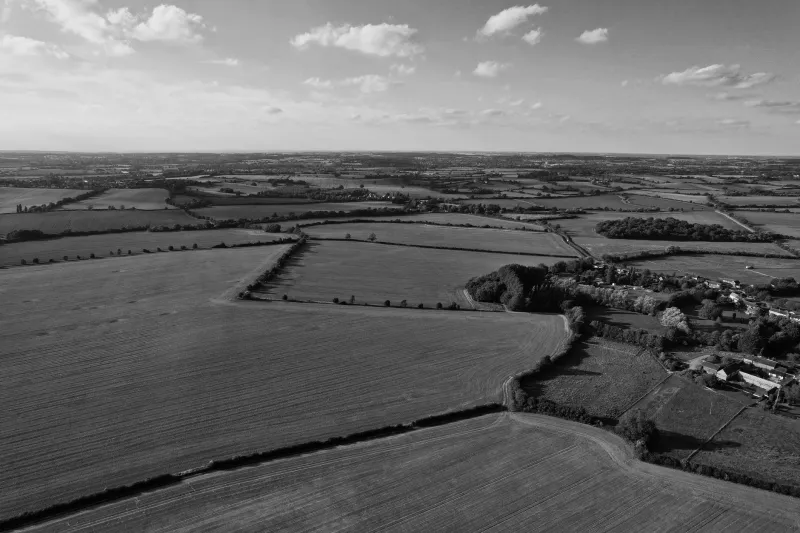
Over three decades, that instinct has produced an archive of more than forty thousand images, spanning communities across Devon, Somerset, Cornwall and Dorset. Farming families caught between generations. Market traders who've worked the same pitch since before decimalisation. Village halls hosting everything from WI meetings to impromptu discos. It is, in the most literal sense, a portrait of a place — and it has become, almost by accident, an irreplaceable historical record.
The Archive Nobody Asked For
Della is disarmingly modest about the significance of what she's built. She'll tell you she was just taking pictures she liked, and that the archive grew because she was too disorganised to throw things away. But local historians and cultural organisations have taken a rather different view.
In 2019, the Devon Heritage Centre approached her about digitising a portion of the collection. Two years later, a selection of her images formed the centrepiece of a community exhibition in Crediton that drew visitors from across the county. A documentary filmmaker from Bristol has been in talks with her for months about a potential project. And yet Della remains somewhat bemused by the fuss.
"I'm not a historian," she says firmly. "I'm not an academic. I just pointed a camera at things I found interesting and tried not to get in the way."
That self-effacement is part of what makes the work so effective. The people in Della's photographs almost never look like they're performing for posterity. They look like they're getting on with things — because they were.
What's Already Gone
Ask Della which images hit her hardest now, and she'll take you on a quiet tour of loss. The Barnstaple pannier market as it was before the renovation. A small dairy farm near Tiverton that's now a housing estate. A travelling fairground family who worked the same circuit of West Country villages for four generations before the last of them retired.
"There are pictures in that archive of things that simply don't exist anymore," she says. "Not just the buildings or the businesses — the ways of doing things. The knowledge, the rhythm of it. You can't photograph that directly, but sometimes you can catch it in someone's hands, or the way they stand, or the look they give each other when something goes right."
She pauses, refilling her mug.
"That's what I was trying to get at, I think. The texture of it. The feel of a life lived in a particular way in a particular place."
Teaching Others to Look
If the archive represents Della's past three decades, her current preoccupation is with the next generation. For the past four years she has run a low-key but quietly influential mentoring programme from her Exeter studio, working with young photographers — many of them in their late teens and early twenties — who are interested in documentary and community work.
The sessions are informal, practical and deliberately unglamorous. No mood boards, no social media strategy, no talk of building a personal brand. Instead, Della takes her students out into the world — to markets, farms, village events — and teaches them to wait, to observe, and above all to earn trust.
"The biggest mistake young photographers make is rushing," she says. "They want the shot before they've even introduced themselves. The people I've photographed over the years, the ones who've let me into their lives — that took time. Sometimes years. You can't shortcut it."
Several of her former students are now doing serious documentary work of their own across the region. One is building an archive of Cornish fishing communities. Another has spent the past two years photographing the Somerset Levels. Della speaks about them with the kind of quiet pride that she'd never apply to her own work.
"If I can get a handful of people to keep doing this — properly, patiently, with real attention — then the archive carries on in a way," she says. "It doesn't have to be me holding the camera."
The Picture That Hasn't Been Taken Yet
There's no grand conclusion to Della Marsh's story, no tidy ending where the archive is saved and the work is done. She's still shooting. Still printing. Still dragging young photographers to early-morning livestock auctions in the hope that something extraordinary will happen in the ordinary.
The rural West Country is changing — that much is undeniable. Villages that once had three farms now have none. Market towns that hummed with agricultural trade have pivoted toward tourism and second homes. The communities Della has spent her career documenting are not disappearing overnight, but they are shifting, slowly and sometimes irreversibly, into something new.
What Della's archive offers, and what her mentoring work hopes to continue, is something simpler and more stubborn than nostalgia. It's attention. The radical, unfashionable act of looking closely at ordinary people living ordinary lives, and deciding that what you see is worth keeping.
"Someone's got to do it," she says, reaching for her camera bag. "Might as well be us."