Walls That Breathe, Rules That Don't: The Fight to Save Devon and Cornwall's Cob Cottages
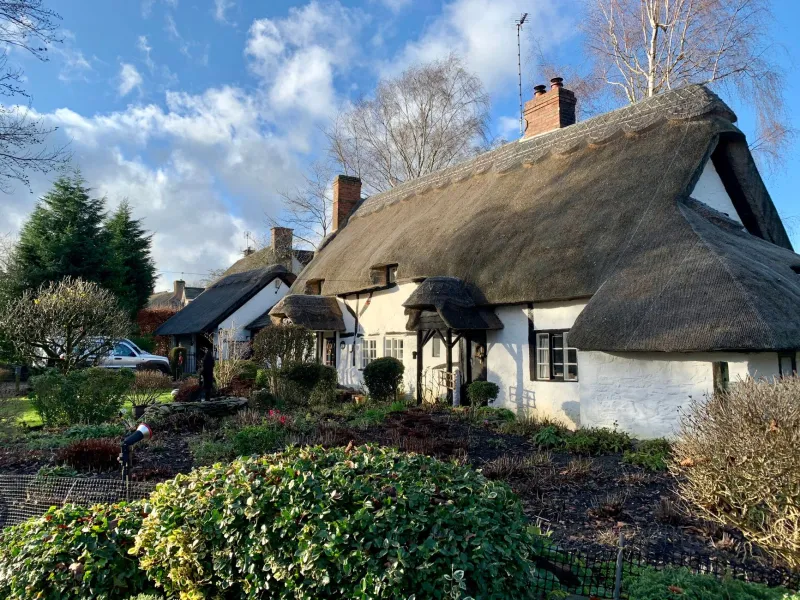
The first thing Jo Penhaligon says when she opens the door of her cottage near Chagford is: "Mind the step — it's not level, and it never will be, and that's fine." The step in question has been not-level for approximately two hundred and fifty years. The walls around it are a metre thick, made of compacted earth mixed with straw, grit, and — if local legend is to be believed — a fair quantity of ox blood. The roof above is deep thatch, the colour of old wheat. The whole structure seems to grow out of the hillside rather than sit on it.
Jo bought the cottage eleven years ago and has spent much of that time in a running battle with building regulations, insurance companies, mortgage lenders, and what she describes, with strained politeness, as "people who've never seen a cob wall in their lives making decisions about cob walls."
She is not alone. Across Devon, Cornwall, and parts of Somerset, the owners of traditional cob and thatch properties — there are estimated to be around fifty thousand such buildings surviving in England, with the heaviest concentration in the West Country — are caught in an increasingly frustrating bind between the demands of modern compliance frameworks and the specific, irreducible nature of the buildings they're trying to preserve.
What Cob Is, and Why It's Different
Cob is, in essence, mud. Specifically, it's a mixture of subsoil, aggregate, and organic fibre — traditionally straw or reeds — that is built up in layers and left to cure. It's been used as a building material in Devon and Cornwall since at least the medieval period, and some surviving examples are considerably older. At its best, it produces walls of extraordinary thermal mass and longevity. There are cob buildings in Devon that have stood for five centuries.
The critical characteristic of cob — the thing that makes it both remarkable and problematic in the context of modern building standards — is that it breathes. Unlike brick or concrete, cob absorbs and releases moisture. It needs to. Trap moisture inside a cob wall with an impermeable render or an inappropriate insulation product, and the wall doesn't just deteriorate: it can collapse.
"Cob needs to get wet and dry," explains Tom Varley, a conservation builder based near Totnes who has specialised in traditional earthen construction for twenty years. "That's not a flaw, that's how it works. The moment you treat it like a conventional wall — seal it up, pump it full of mineral wool, stick impermeable paint on it — you've essentially started a slow demolition."
This is where the friction begins. Because modern building regulations, energy efficiency requirements, and mortgage lending criteria are almost all designed around the assumption that walls are impermeable. The entire framework of damp-proofing, cavity wall insulation, and energy performance certification was developed for modern construction and retrofitted, often badly, onto a building stock that operates on entirely different principles.
The EPC Problem
Energy Performance Certificates — the A-to-G ratings that now determine a property's mortgageability and, increasingly, its legality as a rental — have become a particular flashpoint. Traditional cob and thatch buildings routinely score poorly on EPC assessments, often rating E or F, because the standard assessment methodology doesn't account for the thermal behaviour of earthen walls.
"An EPC assessor comes in with a checklist," says Jo Penhaligon. "No cavity wall insulation: tick. No double glazing: tick. No damp-proof course: tick. They don't have a category for 'walls that have regulated their own temperature perfectly well since the reign of Charles II.' So I get an F, and suddenly my mortgage lender is nervous."
From 2025 onwards, proposed regulations would have required rental properties to achieve at least an EPC rating of C — a threshold that would have rendered many traditional cob and thatch properties unlettable overnight. Though the immediate implementation of that requirement has been delayed, the direction of travel remains a source of acute anxiety for owners of historic properties.
Historic England has published guidance acknowledging the problem. Several local authorities in the South West have developed supplementary planning policies that attempt to accommodate traditional buildings. But the gap between published guidance and on-the-ground practice remains wide.
Demolition by Neglect — and by Regulation
Conservationists argue that the regulatory pressure is contributing to a pattern they call "demolition by neglect" — where owners, unable to afford or navigate the compliance requirements for sympathetic repair, simply let traditional buildings deteriorate until they become uninhabitable, at which point demolition becomes the path of least resistance.
"We are losing these buildings," says Clare Hutchings, chair of the Devon Vernacular Building Group, an organisation that campaigns for better protection of traditional construction. "Not all at once, not dramatically. One at a time, quietly, because someone couldn't get a mortgage, or couldn't afford a specialist contractor, or got bad advice from a builder who'd never worked with cob before and used the wrong materials. Death by a thousand cuts."
The shortage of skilled specialists is itself part of the problem. Traditional cob repair requires particular knowledge and experience — the wrong lime render, the wrong approach to a damp patch, and you can cause more damage than you prevent. Training in traditional building methods has declined sharply over the past thirty years, and the handful of practitioners who do specialise in it are in heavy demand and commensurately expensive.
Tom Varley estimates he could fill his diary three times over with enquiries from owners of traditional properties who can't find anyone competent to work on them. "I turn people away every week," he says. "Not because I don't want to help, but because there aren't enough of us."
The People Pushing Back
There is, however, a growing movement pushing for change. The Devon Vernacular Building Group has been lobbying — with increasing volume — for a separate assessment framework for pre-1919 traditionally constructed buildings, arguing that the current EPC methodology is simply not fit for purpose when applied to earthen construction.
The Cob Research Unit at Plymouth University has been producing evidence to support that case, documenting the actual thermal performance of cob walls in ways that challenge the assumptions built into standard assessment tools.
And at the grassroots level, organisations like the Devon Earth Building Association have been running training courses, producing guidance documents, and building a network of owners, builders, and planners who understand the specific needs of earthen architecture.
"What we're asking for isn't special treatment," says Clare Hutchings. "We're asking for appropriate treatment. A framework that understands what these buildings are and how they work, rather than one that penalises them for not being something they were never designed to be."
What Happens If We Lose Them
Back in Chagford, Jo Penhaligon makes tea in a kitchen where the ceiling has a slight but definitive bow in it that she has learned to regard with affection. The walls, she points out, are cool in summer and warm in winter without any mechanical intervention whatsoever. The thatch roof, replaced seven years ago at considerable expense, provides insulation that she describes as "genuinely extraordinary."
"I'm not living in a museum," she says. "This is my home. It works. It's worked for centuries. What I need is for the systems around it — the regulations, the financial products, the professional frameworks — to catch up with what the building already knows how to do."
If they don't, the buildings themselves will offer their own verdict. Cob is patient. It has outlasted empires, agricultural revolutions, and the internal combustion engine. Whether it can outlast a poorly designed energy performance assessment remains, rather urgently, to be seen.