Beautiful Wreckage: The Artists Dragging the Sea's Dirty Secrets onto Dry Land
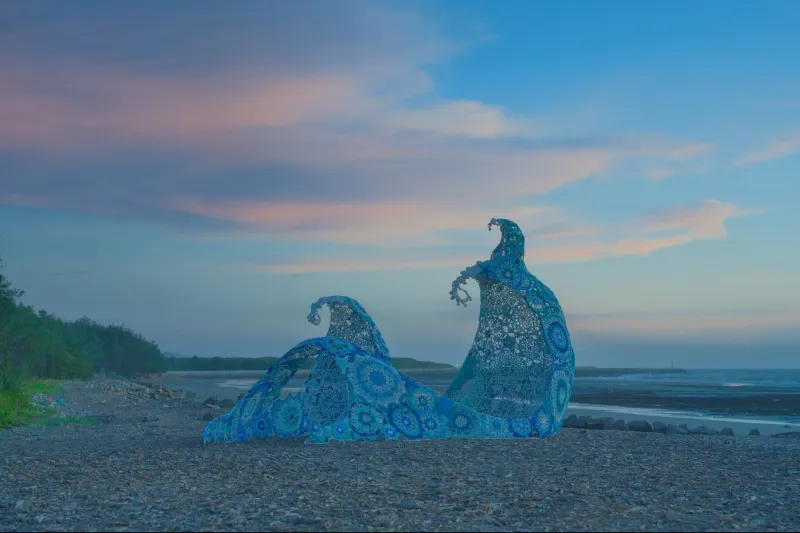
There's a horse on the cliff above Porthtowan. Not a real one — though from a distance, you might need a moment to be sure. It stands about eight feet tall, its mane caught mid-toss in an imaginary wind, its flanks rippling with a texture that takes a while to place. Closer up, you start to see it: the knotted fishing net that forms its neck, the crushed plastic bottles pressed into its haunches, the tangle of orange rope that trails from its tail like something half-free.
The artist who made it, a Cornish sculptor named Jenna Treloar, spent four months collecting material from a ten-mile stretch of coastline before she began. The horse took six weeks to build. It stood for three months before the council asked her to take it down. By then, photographs of it had been shared tens of thousands of times.
"That was the point," Jenna says, perched on a rock near where it used to stand. "Not to lecture anyone. Just to make something beautiful out of something shameful and let people work it out for themselves."
The Coastline as Raw Material
The West Country has one of the most spectacular coastlines in Britain, and one of the most polluted. The geography that makes it so dramatic — the way it juts into the Atlantic, the tidal patterns that funnel debris into coves and estuaries — also makes it a magnet for marine waste. Beachcombers know this. Surfers know this. Scientists know this. Now, a loosely connected community of artists is making it impossible for anyone else to ignore.
From the Isles of Scilly to the Jurassic Coast, visual artists, installation makers and community sculptors are gathering what the sea deposits and turning it into work that is simultaneously beautiful, disturbing and stubbornly difficult to look away from.
The materials they work with vary. Some focus on single-use plastics — the bottles, bags and packaging that break down slowly into microplastics but persist in recognisable form for decades. Others work with ghost fishing gear: the nets, lines and traps that are abandoned or lost at sea and continue to catch and kill marine life indefinitely. A few deal in industrial waste — the fragments of equipment, the chemical containers, the unidentifiable synthetic debris that washes up with no obvious origin story.
All of them are making work that starts with a walk on the beach.
Nets, Knots and Narratives
In a studio on the outskirts of Falmouth, Marcus Webb is surrounded by what he calls his "archive" — a floor-to-ceiling arrangement of collected coastal debris, sorted loosely by colour and material. He's a textile artist by training, and his speciality is ghost net: the decommissioned or lost fishing gear that drifts through the ocean, trapping seabirds, entangling seals and strangling coral.
"People don't realise how much of it there is," he says, lifting a coil of sun-bleached green netting. "Hundreds of thousands of tonnes, globally. And it doesn't stop fishing just because nobody's pulling it. It just keeps going."
Marcus's installations take these nets and reconstruct them into forms that echo the creatures they kill — large-scale suspended pieces that billow and shift with the air, resembling jellyfish, or shoals of fish, or something more abstract and more unsettling. His work has appeared in galleries in Truro and Plymouth, and last summer he installed a piece in the courtyard of a Penzance hotel that drew more footfall than the building had seen in years.
"I don't want to make work that only talks to people who already care," he says. "The gallery is fine. But the courtyard is better. The cliff is best."
Community and Coast
Not all of this work is made by individual artists working in isolation. Some of the most striking projects emerging from the West Country are collaborative — community-led beach cleans that double as collective art-making sessions, with the gathered material transformed into large-scale pieces that are then exhibited or installed in public spaces.
In Bude, a community group has been running monthly gathering sessions for two years, combining coastal clean-up with creative workshops. The results have included a twelve-metre mural made from flattened plastic bottles, a series of mosaic panels installed in the town's main car park and a mobile exhibition that has toured village halls across north Cornwall.
"We wanted to make it about more than guilt," says one of the organisers, a local art teacher named Rachel Fosse. "Guilt doesn't change behaviour for very long. Wonder does. So we try to make things that are genuinely wonderful, and let the material speak for itself."
There's a political edge to some of this work, too — an explicit engagement with the corporate and systemic failures that put the waste in the sea in the first place. One Dorset-based artist, who works under the name Tideline, has been creating a long-running series of works that incorporate the branding visible on collected plastic: the logos, the product names, the corporate colours that survive long after the product itself has dissolved. The effect is eerie — a consumer landscape rendered in wreckage.
What Happens Next
The question that hangs over all of this work is whether art can actually change anything. It's a question the artists themselves are ambivalent about.
"I don't think a sculpture stops a container ship dumping its waste," admits Jenna Treloar. "But I think it changes how a child looks at the beach. And that child grows up. So maybe."
Marcus Webb is more direct. "The stuff is going to keep coming," he says. "So we might as well do something with it. And if it makes someone uncomfortable enough to vote differently, or buy differently, or just pick something up off the sand — then it's done more than it had any right to."
Back on the cliff above Porthtowan, there's no horse now. Just the sea, and the wind, and the plastic catching the light at the tide line. Someone has started collecting it into a pile. It's hard to tell if they're cleaning up or starting something new.