Needle, Thread and Memory: The Somerset Woman Who Reads Old Cloth Like a Diary
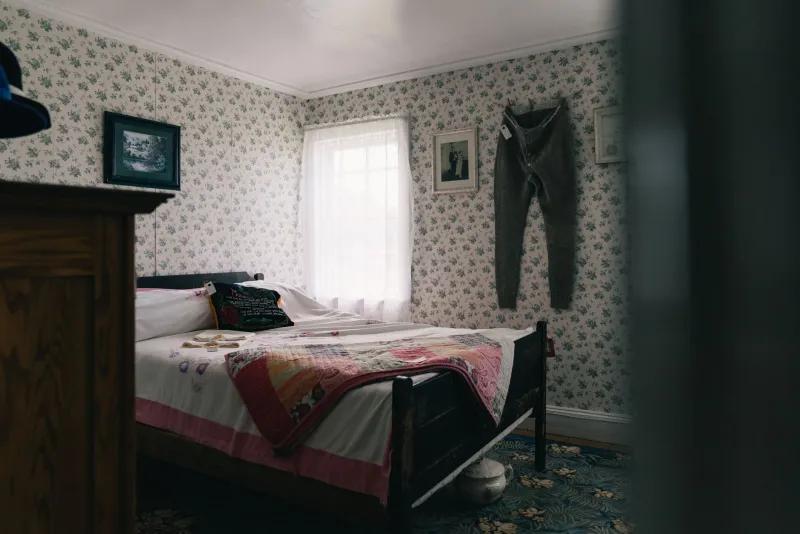
There's a quilt on Ruth Calloway's work table that hasn't been properly seen in about eighty years. It arrived rolled inside a bin bag, passed along by a woman in her seventies whose mother had tucked it away in a loft sometime before the war. The colours — a dusty rose, a faded indigo, a cream that might once have been white — are still there if you look hard enough. Ruth is looking very hard indeed.
"Textiles don't lie," she says, without lifting her eyes from the fabric. "People do, documents do, photographs get mislabelled. But cloth keeps its own record."
Ruth has been restoring heirloom textiles for nearly two decades from her workshop on the edge of Taunton — a converted outbuilding that smells of beeswax and old linen and something faintly botanical she can't quite name. She works on quilts, samplers, tapestries, embroidered panels, christening gowns, mourning cloths. The full, strange, tender archive of domestic life as it was once expressed through thread.
The Detective in the Details
Before Ruth touches a single stitch, she studies. She photographs. She measures thread counts and notes dye techniques. She holds fabric up to natural light at different angles, looking for repairs that were made decades ago, for where a pattern was interrupted and restarted, for the particular way a maker held their needle — right-handed or left, confident or tentative, in a hurry or with all the time in the world.
"Every piece is a crime scene, in a way," she says, laughing slightly at herself. "You're looking for evidence. Who made this? When? What did they have access to? What were they trying to say?"
The sampler she's currently restoring alongside the quilt came from a family in Bridgwater. It dates, she believes, to somewhere around 1820, and it bears the initials E.M.W. in cross-stitch, along with a verse from Proverbs and a border of strawberries that she suspects was copied from a pattern book circulating in Somerset at the time. The stitching is uneven in places — a child's work, she thinks, probably aged ten or eleven. The kind of thing made to demonstrate competence and piety in equal measure.
"Girls made samplers to show they could do it," Ruth explains. "It was almost like a certificate. But the choices they made — the colours, the little additions they snuck in at the edges — that's where the personality comes through. That's where you find the person."
What Gets Lost When Cloth Gets Thrown Away
Ruth came to textile restoration through a circuitous route — a fine art degree in Bristol, a few years working in costume for a regional theatre company, then a growing obsession with historical fabric that eventually eclipsed everything else. She trained under a conservator in Bath and eventually set up on her own, building a quiet reputation that now brings work to her from across the West Country and beyond.
She's evangelical, in a gentle way, about what's at stake when families clear out old homes and bin what they don't recognise. "People see something faded and fragile and assume it's rubbish," she says. "They don't realise they're holding someone's entire emotional life."
She tells me about a tapestry panel she worked on two years ago — a hunting scene, clearly Victorian, found in a skip outside a farmhouse in north Devon. The family who'd commissioned its removal had no idea what it was. Ruth did: it was almost certainly made by the women of the household as a collaborative project, a common practice in the mid-nineteenth century, and the faces of the riders had been subtly, cheekily altered to resemble actual family members. She found a photograph that confirmed it. The family, once contacted, were stunned.
"That panel went from a skip to the centre of a family reunion," she says. "People flew back from Australia for it."
The West Country Thread
There's something particular, Ruth thinks, about the textile heritage of this region. The West Country was wool country for centuries — it made fortunes, built churches, shaped entire landscapes. The cloth trade left its mark not just in the grand wool churches of the Cotswold fringe or the mill buildings of Trowbridge and Stroud, but in the domestic textiles that ordinary families made and mended and passed down.
"You find techniques in Somerset quilts that you don't really see elsewhere," she says. "Ways of piecing that were specific to this area. Regional dialects in fabric, if you like."
She's currently working with a local history group to document some of these regional signatures before the knowledge disappears entirely. It's slow work — cross-referencing old inventories, probate records, trade directories — but she finds it thrilling in a way that's hard to explain to people outside the field.
"You pull one thread," she says, with a smile that suggests she's heard the pun before, "and suddenly you're somewhere completely unexpected."
Returning Stories to Families
The quilt on the table, Ruth has now established, was almost certainly made in the 1930s from recycled clothing — she can identify what appear to be patches from a man's work shirt, a child's dress, something that might be a curtain. Depression-era make-do, she suspects, but made with real care. The quilting pattern is a traditional Somerset feather design.
When she returns it to its owner, she'll include a written report — her findings, her methods, what she was able to determine and what remains uncertain. She does this for everything she works on. It's become a kind of parallel archive, a growing collection of recovered stories.
"The textile is the object," she says, finally setting down her magnifying glass. "But the story is what people actually need. The object is just the way in."
She picks up her needle. The rose-coloured patch needs attention first. She has a lot of ground to cover.